Vegetarianism
“The greatness of a nation and its moral progress can be judged by the way its animals are treated.”
- Mahatma Gandhi
Esteemed leaders like Gandhi and Einstein have long advocated the virtues of vegetarianism, a philosophy deeply embedded in Hindu scriptures. Ancient texts such as the Mahabharata and Padma Purana extol Ahimsa (non-violence) as the highest virtue, a principle also enshrined in the Shikshapatri, the ethical code authored by Bhagwan Swaminarayan. In Hinduism, vegetarianism transcends mere dietary preference; it represents a comprehensive way of life grounded in devotion and compassion.
Addressing common concerns about nutritional adequacy, the American Dietetic Association affirms that a well-planned vegetarian diet can fulfill all essential nutrient requirements. With abundant protein sources from dairy, grains, beans, nuts, and seeds, vegetarianism offers a nutritionally rich and ethically fulfilling lifestyle choice.
Vegetarianism in the Hindu context is about more than just diet. It is a way of living that incorporates special rituals, singular devotion to God, and an unwavering belief in nonviolence. It is the last concept of nonviolence that has begun to make vegetarianism more popular, for to be a vegetarian is to understand that for one to contribute towards a more peaceful society we must first tackle the violence in our own hearts and expressed in our actions. So, it’s not surprising that thousands of people from all walks of life have become vegetarian. Among those who have become vegetarian for the sake of peace are Benjamin Franklin, Isaac Newton, Henry David Thoreau, Ralph Waldo Emerson, Mahatma Gandhi, Albert Einstein, Leonardo-da-Vinci, and George Bernard Shaw.
Skeptics argue that a vegetarian diet does not fulfill human dietary requirements, yet the American Dietetic Association has affirmed that a vegetarian diet can meet all known nutrient needs. The key is to eat a wide variety of foods like fruits, vegetables, leafy greens, legumes, and whole grain products such as nuts and seeds. Dairy products, grains, beans, and nuts are all concentrated sources of protein. Cheese, peanuts, and lentils, for instance, contain more protein per ounce than hamburger, pork, or porterhouse steak. Remember, the vegetable kingdom is the real source of all protein. Vegetarians directly eat the protein instead of getting it second-hand from animals.
Mahatma Gandhi adopted a strong ethical stance in support of vegetarianism. “I do feel,” he stated, “that spiritual progress does demand at some stage that we should cease to kill our fellow creatures for the satisfaction of our bodily wants.” He also said, “The greatness of a nation and its moral progress can be judged by the way its animals are treated.”
As mentioned earlier, within Hinduism, Vegetarianism is directly related to spirituality as a tool to help us develop our appreciation and love of God. In important Hindu scriptures such as the Mahãbhãrat (3-207-7), the Vãsudev Mãhãtmya (20/21), and the Padma Purãn (1.31.27), Ahimsã - non-violence towards all living creatures - is referred to as the highest virtue of life. A practical application of Ahinsã is vegetarianism. Bhagwan Swãminãrayan, the founder of the Swaminarayan Sampradaya and the BAPS Swaminarayan Sanstha, has referred to the practice of Ahimsã throughout His Shikshãpatri - the code of conduct for devotees. The following are two verses from this Holy Scripture referring to nonviolence:
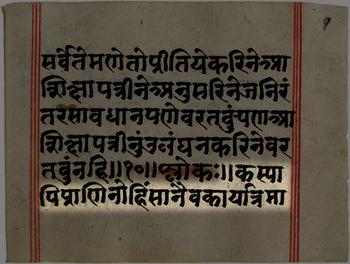 My devotees shall never intentionally kill or harm any living being, not even small insects such as lice or bugs.
(Shikshapatri-Verse 11)
My devotees shall never intentionally kill or harm any living being, not even small insects such as lice or bugs.
(Shikshapatri-Verse 11)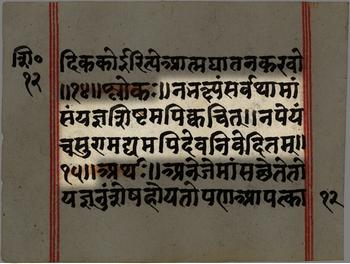 One shall never eat any animal product (even in a moment of extreme necessity), not even remnants of an offering in a sacrifice. One shall never drink intoxicating beverages.
(Shikshapatri-Verse 15)
One shall never eat any animal product (even in a moment of extreme necessity), not even remnants of an offering in a sacrifice. One shall never drink intoxicating beverages.
(Shikshapatri-Verse 15)
Most important, however, is the practice of offering such vegetarian food to the images of God. It is an act of devotion and show of gratitude to God for his countless blessings.
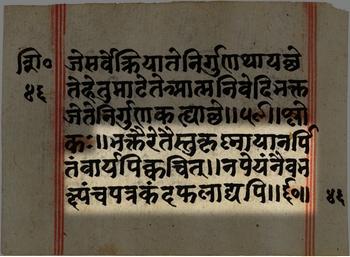 Ãtmanivedi (true) devotees should not eat or drink any such thing which is not offered first to God as an offering.
(Shikshapatri-Verse 60)
Ãtmanivedi (true) devotees should not eat or drink any such thing which is not offered first to God as an offering.
(Shikshapatri-Verse 60)
For more information on vegetarianism, click here.
*Note: All images of the holy Shikshapatri have been taken from the Oxford Bodleian Library’s Digital Shikshapatri Project.
Want to Experience Our Hospitality